There are a number of streaming services on the market today, and one that focuses on science content and documentaries is Curiosity Stream. It is...

Vous n'êtes pas connecté
- English
- Français
- عربي
- Español
- Deutsch
- Português
- русский язык
- Català
- Italiano
- Nederlands, Vlaams
- Norsk
- فارسی
- বাংলা
- اردو
- Azərbaycan dili
- Bahasa Indonesia
- Հայերեն
- Ελληνικά
- Bosanski jezik
- українська мова
- Íslenska
- Türkmen, Түркмен
- Türkçe
- Shqip
- Eesti keel
- magyar
- Қазақ тілі
- Kalaallisut ; kalaallit oqaasii
- Lietuvių kalba
- Latviešu valoda
- македонски јазик
- Монгол
- Bahasa Melayu ; بهاس ملايو
- ဗမာစာ
- Slovenščina
- тоҷикӣ ; toğikī ; تاجیکی
- ไทย
- O'zbek ; Ўзбек ; أۇزبېك
- Tiếng Việt
- ភាសាខ្មែរ
- རྫོང་ཁ
- Soomaaliga ; af Soomaali
Rubriques :
 Maroc - ABUDHABIMAGAZINE.AE - A La Une - 14/Nov 00:27
Curiosity Blog, Sols 4702-4708: It’s Only Spooky Here on Earth Today!

Curiosity Blog, Sols 4702-4708: It’s Only Spooky Here on Earth Today! By Susanne P. Schwenzer, Professor of Planetary Mineralogy at The Open University, U.K. Earth planning date: Friday, Oct. 31, 2025 I am writing this blog and it’s still daytime — and I am looking forward to accompanying one of my favorite kids to trick-and-treating afterwards. That’s a new feeling for me because I am usually Curiosity Navigation Curiosity Home Mission Overview Where is Curiosity? Mission Updates Science Overview Instruments Highlights Exploration Goals News and Features Multimedia Curiosity Raw Images Images Videos Audio Mosaics More Resources Mars Missions Mars Sample Return Mars Perseverance Rover Mars Curiosity Rover MAVEN Mars Reconnaissance Orbiter Mars Odyssey More Mars Missions Mars Home 4 min read Curiosity Blog, Sols 4702-4708: It’s Only Spooky Here on Earth Today! NASA’s Mars rover Curiosity acquired this image at the start of the drilling activity at the “Valle de la Luna” site, “caught in the act” as this image was taken on Oct. 19, 2025. Curiosity used its Front Hazard Avoidance Camera (Front Hazcam) on Sol 4693, or Martian day 4,693 of the Mars Science Laboratory mission, at 01:54:37 UTC. NASA/JPL-Caltech By Susanne P. Schwenzer, Professor of Planetary Mineralogy at The Open University, U.K. Earth planning date: Friday, Oct. 31, 2025 I am writing this blog and it’s still daytime — and I am looking forward to accompanying one of my favorite kids to trick-and-treating afterwards. That’s a new feeling for me because I am usually in the U.K., which means my Curiosity shifts start in the late afternoon when everyone else finishes working. But for now, I am in the U.S. (Houston, Texas), and it’s daytime, which is a lovely change, especially today as I don’t have to hide from trick-and-treaters’ interruptions but instead can give out all the candy they can possibly eat! Looking forward to that… but before, let’s see what Curiosity was up to this week! You’ll have seen the blog by my colleague Bill, “Searching for Answers at Monte Grande,” about our analysis of the “Valle de la Luna” sample with CheMin and SAM EGA. This week we were continuing the SAM analysis of the 44th drilled sample, which always takes a lot of power, so that leaves less room for other investigations. Hence, you might notice that there were fewer ChemCam and Mastcam activities. The rover also did not drive while sample is still in the turret ready for delivery of the next SAM activities. Curiosity has now completed the deliveries to CheMin and SAM, though, and the last action in Friday’s plan was to clean out the remaining sample from the drill in preparation for driving away here in Monday’s plan. In Monday’s plan we’ll reposition the rover to get a very good look at the potential next drill targets on the ridge. We’ve been able to scout them already in previous images and have a few candidates, but decision-making will require images from Monday’s parking position, since we are currently parked in a hollow and cannot really see what’s up on the ridge. That said, being stationary has always been a golden opportunity for looking at wind action, and this week was no difference as Mastcam looked at the drill fines several times over the time we were stationary, to ascertain the safety for MAHLI to approach — and of course to use those images for atmospheric science, too. In addition, Mastcam took the opportunity to get comprehensive imaging of the entire area. There are several mosaics that document the near-field, for example at target “Nazareth.” In the mid- and far-field distances, Mastcam assembled a large mosaic on “Monte Grande” and “Ticaco” to document the different rocks in the surrounding ridge walls and wider afield. There are so many interesting textures and alteration features, alongside troughs and fractures, that the team will have a fun time analyzing them all in great detail individually, as well as their relationships to each other. ChemCam has investigated the Valle de la Luna drill hole and tailings as per the usual cadence of post-drilling activities, and in addition investigated target Nazareth to understand how the block that Curiosity drilled might vary chemically. Another ChemCam target was “Pachica,” as the team observed many nodules in this target and we are interested in their chemical variability and “Palpana,” a more smooth block. Further investigations of the Valle de la Luna drill hole with ChemCam are targets “Anapia” and “Bandara” to further investigate the chemical diversity of the drill target block. ChemCam Remote Micro Imager (RMI) observations were also taken in the near-field and farther away. In the near-field, RMI images are documenting further details on the Valle de la Luna drill hole and its tailings, while further afield the Monte Grande Wall is one of the RMI targets alongside with other details in the boxwork ridges around us. On Friday, the RMI was pointed far uphill to continue imaging the yardang unit, which is one of our next goals in the longer term future. In addition to all the drill activities and rock investigations, the atmosphere received attention too. We have the usual cadence of environmental investigations, building our long-term pressure, temperature, and humidity record of Mars; and we observe the atmospheric opacity, dust-devil activities, and clouds. Of course, we are all looking forward to next week, when we will decide on the second drill target in this area, this time on the ridge. Let’s see what block will be looking best, both from a science and an engineering point of view – we’ve got a short list of candidates; the detailed images are for Monday’s plan. Meanwhile, we’ll enjoy trick-and-treating here on Earth and our weekends while Curiosity finishes the drill activities at Valle de la Luna. Want to read more posts from the Curiosity team? Visit Mission Updates Want to learn more about Curiosity’s science instruments? Visit the Science Instruments page NASA’s Mars rover Curiosity at the base of Mount Sharp NASA/JPL-Caltech/MSSS Share Details Last Updated Nov 13, 2025 Related Terms Blogs Explore More 3 min read Curiosity Blog, Sols 4695-4701: Searching for Answers at Monte Grande Article 40 minutes ago 3 min read Curiosity Blog, Sols 4689-4694: Drill in the Boxwork Unit is GO! Article 43 minutes ago 4 min read Curiosity Blog, Sols 4682-4688: Seven Mars Years Article 50 minutes ago Keep Exploring Discover More Topics From NASA Mars Mars is the fourth planet from the Sun, and the seventh largest. It’s the only planet we know of inhabited… All Mars Resources Explore this collection of Mars images, videos, resources, PDFs, and toolkits. Discover valuable content designed to inform, educate, and inspire,… Rover Basics Each robotic explorer sent to the Red Planet has its own unique capabilities driven by science. Many attributes of a… Mars Exploration: Science Goals The key to understanding the past, present or future potential for life on Mars can be found in NASA’s four…
Articles similaires

Curiosity Stream Targets Content Licensing Revenue to AI Companies to Overtake Subscription Revenue by 2027
thecekodok.com - 23/Nov 11:04
There are a number of streaming services on the market today, and one that focuses on science content and documentaries is Curiosity Stream. It is...
10 years of Science Forum South Africa: Advancing technology and innovation
wn.com - 26/Nov 12:01
Science, technology and innovation (STI) hold immense promise for humanity to build a just and humane world. But this can only be achieved if we...

Is AI making us stupid? – podcast
theguardian.com - 05:00
Artificial intelligence can execute tasks in seconds that once took humans hours, if not days to complete. While this may be great for productivity,...
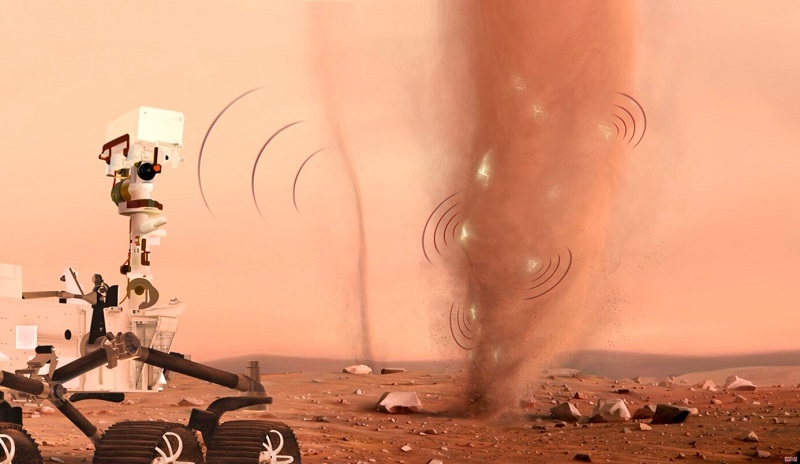
Scientists capture the sound of sparks on Mars
knowridge.com - 27/Nov 15:03
For the first time, scientists have confirmed that tiny bursts of electricity are happening in the atmosphere of Mars. These sparks were picked up by...
Scientists capture the sound of sparks on Mars
knowridge.com - 27/Nov 15:03
For the first time, scientists have confirmed that tiny bursts of electricity are happening in the atmosphere of Mars. These sparks were picked up by...
Scientists capture the crackling sounds of what they believe is lightning on Mars
wn.com - 26/Nov 20:36
By MARCIA DUNN, AP Aerospace Writer CAPE CANAVERAL, Fla. (AP) — Scientists have detected what they believe to be lightning on Mars by eavesdropping...
Scientists capture the crackling sounds of what they believe is lightning on Mars
wn.com - 26/Nov 20:36
By MARCIA DUNN, AP Aerospace Writer CAPE CANAVERAL, Fla. (AP) — Scientists have detected what they believe to be lightning on Mars by eavesdropping...
Without US satellites, 'we go dark', tells climate monitor
wn.com - 19/Nov 11:02
US budget cuts risk creating blind spots in Earth monitoring systems that would imperil weather forecasting and climate research for years to come,...
Without US satellites, 'we go dark', tells climate monitor
wn.com - 19/Nov 11:02
US budget cuts risk creating blind spots in Earth monitoring systems that would imperil weather forecasting and climate research for years to come,...
Les derniers communiqués
-
Bombardier Advances Services Expansion as Construction of Landmark Abu Dhabi Facility Accelerates
Bombardier - 03/12/2025
-
Al Habtoor Polo Resort Partners with Emirates Post to Revive the Joy of Sending Festive Postcards This Holiday Season
Al habtoor polo Resort - 03/12/2025
-
UAE Pavilion welcomes senior officials on day one of Egypt Defence Expo 2025
Edge Group - 02/12/2025
-
Minister of Economy & Tourism: 77.5% non-oil share of real GDP; AED36 bn hotel revenues mark exceptional growth on 54th Eid Al Etihad
Dubai Department of Economy and Tourism - 02/12/2025
-
Minister of Economy & Tourism: 77.5% non-oil share of real GDP; AED36 bn hotel revenues mark exceptional growth on 54th Eid Al Etihad
Ministry of Economy - 02/12/2025
-
AMMROC signs three strategic MoUs with the Arab Organization for Industrialization in Egypt at EDEX 2025
Advanced Military Maintenance Repair & Overhaul Center (AMMROC) - 02/12/2025
-
AMMROC signs three strategic MoUs with the Arab Organization for Industrialization in Egypt at EDEX 2025
Advanced Military Maintenance Repair & Overhaul Center (AMMROC) - 02/12/2025
-
Mubadala Energy, PLN Energi Primer Indonesia sign Heads of Agreement to strengthen Indonesia’s energy resilience
Mubadala Energy - 01/12/2025
-
Ministry of Finance to implement amendments to the Tax Procedures Law starting early 2026
Ministry of finance - 01/12/2025
-
Ministry of Culture, Emirates Association for Social Development sign cooperation agreement
DUBAI CULTURE - 01/12/2025